

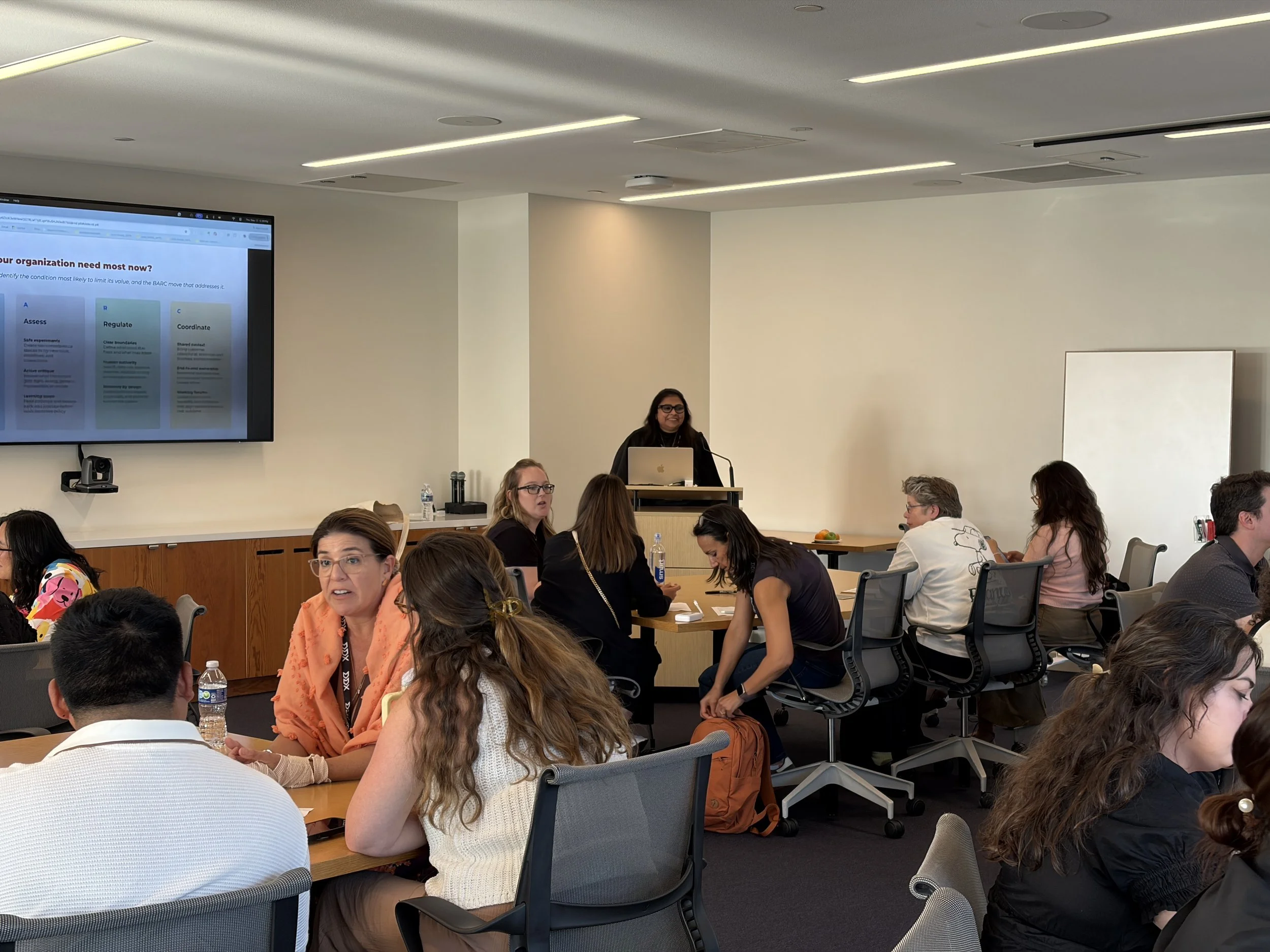
Your team’s judgment is being shaped right now. Design it on purpose.
Every task you automate, every handoff, every metric you reward changes how your people learn to decide. These workshops help teams see what's shaping their judgment, spot where it's eroding, and redesign work so it keeps growing.
Teams rarely fail because of bad people or bad intentions. They fail when judgment quietly erodes.
It rarely shows up as a crisis. It shows up in four quiet ways.
The easy work disappears.
The first draft, the routine review, and the small correction teach people what good looks like. Automate them without a plan, and that learning goes too.
No one owns the call.
Decisions get spread across people, tools, and handoffs until no one can say who judged what or why. When something breaks, no one is there to catch it.
The metrics stay green.
Speed, output, and adoption go up while your team’s ability to question an answer or handle an exception goes down. Nobody measures it until it matters.
No one questions the output.
Confident outputs stop getting questioned. Over time, people lose the habit of pushing back and the skill to spot when the answer looks right but isn’t.
Who is this for?
Leadership teams adopting AI
Decide what to automate, what to augment, and where your people must stay accountable.
Product, design + operations teams
Redesign workflows so speed doesn’t cost your team the judgment it depends on.
HR, L&D + talent leaders
Protect how early-career people learn, even as the work they used to learn on disappears.
Transformation + change offices
Measure whether AI is building capability, not just adoption and output.
The approach: See it. Spot it. Shift it.
-
See It
Make visible the forces shaping how your team decides: unspoken rules, inherited assumptions, incentives, and the tools now doing part of the work.
-
Spot It
Find where judgment is at risk: tasks AI is taking over, decisions no one owns, and metrics that hide capability loss. Teams run the Green Dashboard Test on their own measures.
-
Shift it
Redesign the work so people keep practicing. Using the Decision Risk Matrix, teams decide what to automate, what to augment and where people must stay accountable.
Half Day: See It Workshop
Surface the unspoken rules, inherited assumptions, and default patterns shaping how your team makes decisions. Most of what drives your team’s judgment has never been named: who gets to weigh in, which signals get trusted, and what the tools now decide on their own. By learning to see what others move past, your team gains a shared language for how judgment actually works here, and where it’s starting to slip.
What You Will Leave With
Objective 1: A shared language for how your team decides. Most teams feel decisions going sideways but have no words for why. This session gives everyone the same framework for naming what has been invisible.
Objective 2: Clarity on the forces shaping judgment in your context. You'll map the rules, incentives and tools that most influence who decides and how, so you know where to look first.
Objective 3: An honest read on your metrics. Through the Green Dashboard Test, your team checks whether its measures show capability growing, or only speed and output.
Full Day: See it. Spot it. Workshop

Move from awareness to diagnosis. The morning builds a shared language for the forces shaping your team's judgment. The afternoon puts it to work on a real workflow your team brings, tracing where automation, handoffs, and incentives are thinning out the practice people need to decide well. You leave knowing where judgment is at risk and what to change first.
What You Will Leave With
Objective 1: A first-pass Decision Risk Matrix for a real workflow. Your team sorts the work into what to automate, what to augment, and where people must stay accountable.
Objective 2: A map of where judgment, review and accountability belong. You’ll see who recognizes a mistake, who owns the consequences, and where those answers are unclear today.
Objective 3: A prioritized list of what to shift first. Not a long list of problems, but a short list of changes ranked by risk and effort.
8 Sessions: See it. Spot it. Shift it.
A sustained practice, not a one-time training. Over 16 weeks, your team learns to see the forces shaping its judgment, spot where it’s at risk, and redesign real work so people keep building expertise as AI takes on more. Between sessions, teams test changes in their own workflows and bring back what they learned, so the shifts hold after the program ends.
8 sessions · 120 minutes every other week · Teams of up to 20 · In person or virtual
What You Will Leave With
Objective 1: Diagnose your own judgment risks. Your team learns to spot capability loss early, without waiting for the metrics to show it.
Objective 2: Redesigned workflows, tested in practice. Teams rebuild real workflows so learning, feedback, and accountability are designed back in, then test them between sessions.
Objective 3: Habits that keep judgment growing. New ways of reviewing, delegating, and deciding that keep expertise developing as AI adoption scales.